Loving What Is - Accepting Relationships as They ARE
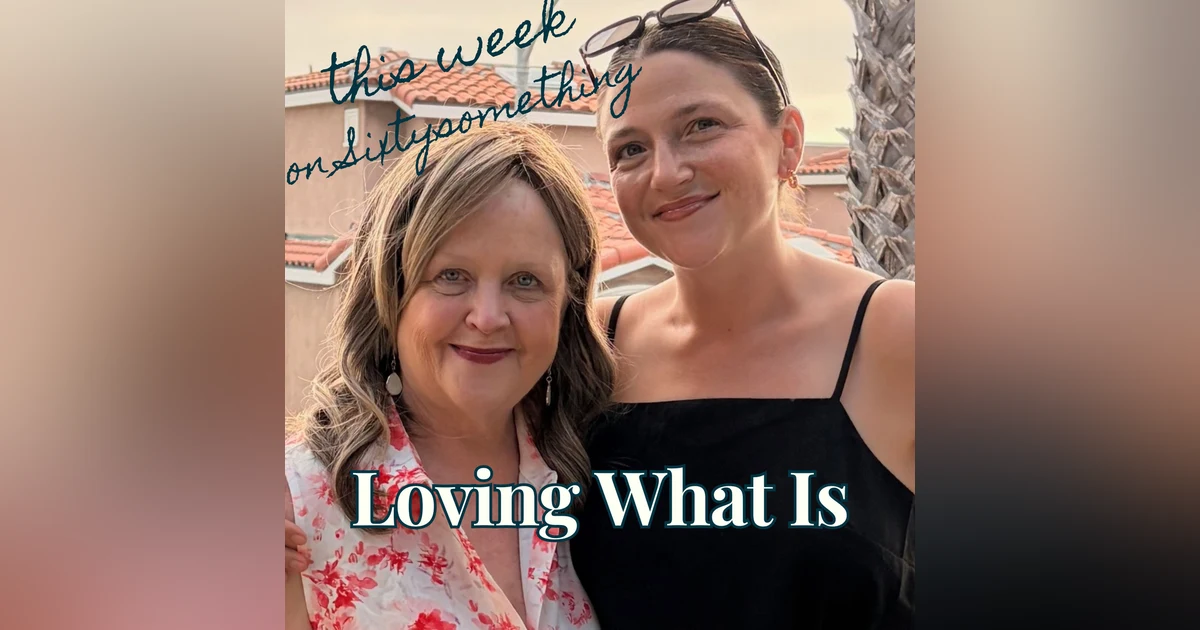
Sixtysomething Season 3, Episode 5: Loving What Is
What happens when someone you love is no longer the person you remember—or when a relationship that was once incredibly close simply isn’t the same anymore?
In this episode, I’m sharing a realization that has changed the way I think about some of the most important relationships in my life: if we want a relationship with someone today, we have to have it with who they are now—not who they used to be.
I talk about my own evolving relationship with my daughter, Juliet, and the moment I realized that while I was still waiting for our old relationship to return, she already considered us close. That one conversation helped me understand what Byron Katie calls loving what is—accepting the reality of a relationship without constantly comparing it to the past.
We’ll talk about adult children, old friendships, expectations, resentment, boundaries, and why distance doesn’t always mean rejection. And perhaps most importantly, how putting down the measuring stick of the past can leave us free to appreciate the love and connection that are actually available to us now.
In this episode:
- Why accepting a changed relationship is not the same as approving of everything about it
- The difference between what actually happened and the story we tell ourselves about it
- Why our grown children may be perfectly happy with a relationship we think is lacking
- How constantly comparing today with yesterday can make us miss what’s still good
- Why bitterness and keeping score cost us far more than they cost anyone else
- Learning to meet the people we love as they are today
- Extending that same acceptance to the person we have become
And I’m introducing our very first Sixtysomething Book Club selection!
Remarkably Bright Creatures by Shelby Van Pelt is the story of Tova Sullivan, a widow in her seventies who works nights at an aquarium and develops an unlikely friendship with Marcellus, an extraordinarily intelligent giant Pacific octopus. It’s warm, funny, mysterious, and filled with themes of loss, family, friendship, and unexpected second chances.
Even better, the novel has now been made into a Netflix film starring Sally Field, so we’ll have both the book and movie to talk about. I'll announce the date for that next week, but It will be in approximately one month from the date of this episode. I want you to have time to read it!
Join us in the Sixtysomething Facebook group to keep the conversation going.
And if you enjoy the podcast, I’d be so grateful if you’d leave a review. It helps more people find Sixtysomething.
Keep your sunny side up!
Sixtysomething Book Club
Remarkably Bright Creatures — Shelby Van Pelt
Learn more about Remarkably Bright Creatures and find buying options
* * * * * * * * * * * * * * * * * * * * * * * * * * * * * * * * * * *
Hey Friends! It's me, Grace! I just want to thank you for listening. I hope you’ll let me know what you think about the podcast and if any particular episodes resonate with you.
Listed just below here is my contact information and all of the social channels where you can find me, as well as the link to our Facebook Group.
Contact Info
Grace Taylor Segal
Email: grace@gracetaylorsegal.com
Facebook: 60something Page
(https://www.facebook.com/profile.php?id=61553062496332)
Instagram: @60somethingpod
Facebook Group: 60Something Pod
https://www.facebook.com/groups/1665326354000332
Links (Mentioned in this episode)
Credits
Sixtysomething Theme Song
Music & lyrics by Lizzy Sanford
Vocals by Lizzy Sanford
Guitar: Lizzy & Coco Sanford
To Leave a Review:
On Apple Podcasts (no link is available--here are the steps)
- Open the Apple Podcasts app.
- Search for the podcast you want to review.
- Select the podcast show page (not an individual episode).
- Scroll to the bottom of the page.
- Click "Write a Review".
On the Sixtysomething Podcast Website
https://www.sixtysomething.net/reviews/new/
Thank you so much for taking the time to review the show!
Timestamps:
00:00 Welcome and Epiphany
02:31 Missing Old Closeness
04:48 Loving What Is
07:49 Grown Kids Change
10:57 Friend’s Daughter Shift
14:19 Stop Measuring by Past
16:34 Juliet Story Begins
21:43 Acceptance and Boundaries
25:06 Drop the Stories
29:36 Avoiding Bitterness
35:22 Acceptance Not Approval
39:34 Eras and Letting Be
48:25 Practice This Reframe
53:30 Book Club and Goodbye
Loving What Is
[00:00:00] Welcome back to 60-Something. I'm Grace, and I'm so glad you're here. I've had something on my mind lately. It actually is an epiphany, though it seems like one of those things that turned out to be perfectly obvious the moment I finally saw it. You know how that goes. You can spend years struggling with something, turning it over like a Rubik's cube, being hurt by it, trying to work it out, figure it out, crack the code.
And then one day you notice the thing that was sitting in plain sight the whole time, but suddenly it's like there's this ray of light shining down and you think, "Oh, of course. Why couldn't I see this before?" That's what happened to me recently with some of the relationships in my life. [00:01:00] My relationships with my adult children certainly, but also a few friendships.
And once I started pulling this thread, I realized it touches nearly every long-term relationship I have. Here's the realization, as plain as I can put it. If I want a relationship with someone I love, I have to be in a relationship with who that person is now. Not who they used to be, not who I assumed they'd become, not who I wish they were.
Who they are today, not some memory of who they used to be
Or even who I wish they were. Somehow understanding [00:02:00] that has changed things. Not the person, not the current circumstances, but the way I now experience them, and that's what I wanna talk about today because I have a feeling there are so many of us in our 60s, in our 70s, and even our 50s, any age really, wrestling with exactly this.
Maybe you have an adult child you were once incredibly close to. He called all the time. You knew everything happening in his life. You spent the holidays together, took trips together, talked two or three times a week or even daily. Now you don't. Maybe it's an old friend, someone who used to be your person.
Something [00:03:00] changed. Often, there's no dramatic falling out, no single terrible moment. Life simply moved along, people changed, circumstances changed, and a relationship that once filled an enormous space in your life now occupies this little small corner of it, and you miss it. Of course you miss it. That's the part I never wanna dismiss lightly because when we talk about acceptance, it can start to sound like saying, "Don't be sad."
Well, you're allowed to be sad. You can miss what you had. You can wish it had gone differently, remember wonderful times, and feel a [00:04:00] real ache knowing that particular version of the relationship is gone. And likely is not coming back. All of that is true, and it's real, and it doesn't need to be fixed.
Fixing is part of the problem. But here's where I kept getting stuck. I was so focused on the relationship I used to have, or the one I told myself I ought to have, that I wasn't really seeing the relationship that was actually available to me, and those are not the same thing. There's a phrase from philosopher and author Byron Katie I keep coming back to with this, [00:05:00] "Loving what is."
It just landed smack in my mind when I had the great realization about my relationship with my daughter recently. Loving what is. It doesn't mean you h- have to love everything that happens to you. There is plenty in this life and in my relationships I don't love at all. Plenty I'd change in a heartbeat if I could.
For me, the whole weight of it sits on that little word "is." Loving what is So what's true? What is actually occurring here? What is reality right now? Because reality, I've noticed, isn't especially [00:06:00] interested in negotiating with me. I can argue with it, complain about it, rebel against it, go into deep denial about it, resent the hell out of it, replay the past over and over, knock my head against the wall, rage and mourn the loss But the truth is that sooner or later, we have to decide what we're gonna do with the reality we've actually got.
I've spent my fair share of time arguing with reality in my relationships long term, and maybe you have too. "She used to call me. We used to be so close. He never used to treat me like this. We always spent [00:07:00] Christmas together. My friend, a real friend, would never have forgotten my birthday or gone six months without calling 10 years ago."
And that may be perfectly accurate and absolutely true, but there's another question sitting quietly beneath all of this. Who is the person now, and what kind of relationship can I actually have with them now, today? That's, that's a different question, and it opens up a whole new way of seeing it, a paradigm shift, if you will.
I used an example of a friend there, but I think it's with our grown children that this is the hardest. When they're little, [00:08:00] we aren't spectators in their lives, we're responsible for them. We make the decisions, we know the friends, the teachers. We know whether they've eaten, and when they're frightened, and when they're excited, and what they're excited about, and where they are at night.
We try to do all these things, and we're-- they're-- when they're little, we're their gods, all-powerful in their young lives. That doesn't last, of course. It can't. It shouldn't. They grow up, which of course is the entire point. We're raising people who were to become adults, but knowing that in your head and living it in your heart, facing the reality of what that's actually like IRL, as they say, in real life, well, they're two [00:09:00] completely different things.
Our babies become people, whole separate people with opinions of their own, priorities we don't always agree with or even understand, partners we didn't choose, ways of parenting and believing and living that may look very little like the child we thought we raised, and they keep changing. Sometimes dramatically, but maybe there's something that-- about being a mother that freezes an image of your child in your mind, and you just keep remembering that little kid or the teenager or the young adult who needed you in a completely different way while the actual person has gone right on living and becoming [00:10:00] and changing without ever checking in with you to revise that picture in your head.
Sometimes they grow into someone we understand perfectly. It's beautiful, and sometimes they don't. But there comes a point when the only thing to do is say to yourself This is who my son is now. This is who my daughter is now. Do I wanna know this person? Not that son from two thousand and five, not the daughter from two thousand and sixteen, not the one I remember or more likely created in my mind, but this one, this real one.
That's hard. Harder than it sounds. I was talking [00:11:00] recently with a friend who has been struggling with exactly this. She's been mourning the relationship she used to have with her daughter, and mourning is the perfect word because there was a closeness years ago that she treasured, and it simply isn't the same now.
There's more distance. It's hurt her, and it's made her a little bitter, and I understand that completely. When you're the one who wants more closeness, the distance feels like rejection. You think, "Why doesn't she want what I want? Why isn't she bothered by this the way I am? How can she seem so content with something that feels so diminished to me?"
I relate to this profoundly because it's [00:12:00] my story too with, with several of my kids, and here's what may be the most bitter pill to swallow, speaking of bitter. Sometimes that person, that grown-up child, isn't unhappy at all. Not at all. They think everything's great. It's just us. We're the ones mourning.
They're just living their lives, and I'll tell you what, that dichotomy there can turn into the ache that turns into resentment in the blink of an eye. As I spoke with my friend about her situation, I shared some of what I've been sorting out in my own life. This idea that maybe there comes a point where we stop trying to rebuild and reconstruct that old [00:13:00] relationship and start asking whether we can accept and maybe even enjoy the one that's actually possible now.
No, not because it's what we'd have chosen, but because it's what's here. Because it is what is Later, she texted to say she reached out to her daughter, and it was nice. Nothing monumental, no movie scene reconciliation, nobody running through the airport, just a warm, friendly little back and forth. And she told me afterward that she felt lighter.
So fascinating, so encouraging because nothing about this situation had really changed. What shifted even a [00:14:00] little was that framework around it. Instead of, "Why can't we have what we used to have?" the question quietly became, "What can we have today?" And there was something there, smaller maybe, different, but real.
This, exactly this, I think, is where we keep making ourselves miserable. God, I know I have. We keep getting out our measuring stick, but the measuring stick is always from the past. Every interaction gets held up against what it used to be. "He only called for 15 minutes. We used to talk for an hour." "She stayed two days, and she used to stay a whole week."
"He used to ask for my advice," and, "She used to tell me everything." And if the past is the standard, the present, well, it's gonna lose almost [00:15:00] every time because the present isn't trying to match the past. It can't be the past. The circumstances that built that old closeness don't exist anymore, and this is the part we forget.
Neither do we. We ourselves aren't standing still while everyone around us transforms. I've changed. You've changed. Maybe the person our kid or friend is today actually needs something different from us. Less advice maybe, fewer questions, more space, more listening without leaping in to fix, and maybe they just don't have the time they once had.
Perhaps none of this is a verdict on how [00:16:00] much they love us. That's a big one, so let me say it again. Distance is not always rejection. Change is not always rejection. Less contact doesn't have to mean less love. I know it feels that way, but sometimes it only means that life changed. So I made you wait, didn't I?
Oh, d- I added some suspense. Did you like that? So, okay, here's what happened with my daughter, Juliet. Over the past month that inspired this episode, and I... A sea change within me. As you may recall, my daughter Juliet and I were very, very close. She was my youngest child, my only daughter, and until she was 23,
we were as close as a mother and daughter [00:17:00] could be all those years. At 23, she met a man who she married, and he did not like me. A normal person could not like me, although I was never anything but nice to him, because I didn't wanna lose her, but he intensely disliked me, and it ruined my relationship with my daughter.
There's no other way to put it. For the five years they were married, I barely saw her. She had three children during that time, and I didn't know 'em. They didn't know me. I wasn't asked to take care of them or anything like that, and it was heartbreaking, you can imagine. Eventually, they split up, and they've gone their separate ways.
That was over four years ago, and I thought everything would sort of snap back into place with me and my daughter. It was [00:18:00] my cherished fantasy, my precious, that would happen But it, it didn't happen. I'd say for the first year it was like pins and needles. She was detoxing from that relationship.
But I do think that certain attitudes that he had, she incorporated in her worldview. For example, she and I were always very physically affectionate. Since her marriage, uh, what I believe is that he convinced her that our close relationship and our affection was s- babyfied, somehow unnatural, and it stopped.
She was very resistant to that, and to a great extent, she still is. That's been really hard for me. Another thing that's been hard [00:19:00] is that even though things improved incrementally, the first year wasn't good. The second year was a little better. The third year she started asking for my help with watching the kids, coming to visit them, and in this fourth year, we've had some conversations that I see as breakthroughs in really letting go of the resentments on both sides that were reactions to preconceived notions that we developed about each other.
As soon as they were spoken, I think we both realized that they weren't valid, at least not anymore, and they evaporated. It was truly magical. Even so, things have never reverted back to the way they were before she became involved with her ex-husband. [00:20:00] And I've been waiting. I've been waiting for that.
Waiting, waiting, waiting. I think it's gonna happen, and then something, she doesn't wanna give me a hug or whatever. It's jarring because I realize, oh, that hasn't changed. I'm waiting. When is that going to come back? I thought recently things seemed very good. They weren't quite there. I said something like that to her and she said, "What are you talking about?
I'm so happy with the way things are." I said, "Well, I just want us to be close again." And she said, "Aren't we?"
Took quite a while for me to circle back to that and I, I [00:21:00] h- I had to think about what that meant. That's, that's when the realization started to come to me. For the person she is now, we are close, and slowly I understood that I had to accept that. There's no other way. If I want a happy relationship with her, I have to let my memory of who she was go for my relationship with her in the present and just accept who she is now.
Uh, yeah, not easy, but we're talking about grownups, and they can make choices we don't agree with in a big way. They can behave badly, become self-centered, make decisions we think are genuinely terrible, [00:22:00] and they can hurt us without ever meaning to by just living their lives. Acceptance doesn't ask us to pretend otherwise, and it certainly doesn't ask that we let anyone abuse, manipulate, or wreak havoc in our lives.
We're allowed to have boundaries. We're allowed to say no. We are allowed to decide that a relationship isn't healthy. But that's another conversation entirely. What I'm talking about is the enormous stretch of territory between we're as close as we ever were and this person cannot be in my life. There is so much room in there, and I think we overlook most of it.
We assume that if the relationship can't be what it was, we've lost it [00:23:00] when really it just may have changed shape. Here's probably the biggest shift in my perspective. What happens if we stop making today's relationship pass a test written for the old one? Your daughter doesn't call you every day anymore, but when she does call, it's a good conversation.
Can that be enough? Your son doesn't tell you everything now, but he sends you a funny picture. Can you just enjoy that without silently adding, "Why doesn't he talk to me about anything that matters?" A friend who used to be a part of your ordinary week is now someone you have lunch with two times a year.
Can those lunches be wonderful? Can we let a relationship [00:24:00] simply be what it is without constantly pointing out to ourselves what it isn't? I keep ask- asking myself that, and more and more my answer is yes, because the alternative isn't secretly gonna get that old relationship back. That's the trap. We tell ourselves the choice is either accept this lesser thing or somehow win back that wonderful old one, when in truth, the old one, it's not on the menu at all.
The real choice is closer than this. Enjoy the relationship that's available now, or spend years being unhappy that it isn't something else. Put that way, the decision seems [00:25:00] much easier. For me, yeah, it's become a no-brainer. We also have to watch the stories we hang on the changes because human beings are incredible storytellers.
Something happens, and within seconds we've built the whole explanation. She doesn't call 'cause she doesn't care. He spends more time with his wife's family. He likes them better. They're richer. My friend didn't invite me because I've become irrelevant to her. She has better friends now. My daughter didn't ask my opinion because she doesn't respect me.
Well, maybe, but maybe not. We know far less than we think about what's going on inside someone else's head, and very often that story we make up hurts much more than the thing itself [00:26:00] ever could. The fact might be my son hasn't called me in two weeks. The story becomes I'm not important to him anymore.
Those are two entirely different statements. One is something you know, the other is something you decide, and once you move to the conclusion and set up house in there, every new interaction becomes evidence for it. Ugh, oh my God, isn't that just the truth? That's the real danger because then even the good things don't get to be good She sends you a sweet text, and you think, she could have called."
He invites you over, and you think, "Well, he just felt obligated." Your friend remembers your birthday, and you think, "Facebook reminded her." We reject the whole relationship, complaining the whole time [00:27:00] that we're the ones being rejected. That's worth thinking about. So one thing I'm trying to do more of is let a good moment just be.
Let it be a good moment without making it predict the future, without turning it into proof everything's fixed or shrinking it down because it, it wasn't good enough. If I have a lovely conversation with someone I haven't been close to lately, I want to enjoy that conversation. That's all. I don't need to declare us back to normal or back together or immediately start wondering when we'll talk again or replay it after to decide whether they sounded enthusiastic enough.
We had a nice talk, good, that's something. Enough. [00:28:00] There's peace in learning to receive what people are offering instead of forever measuring it against what we wish they'd offer I don't wanna make any of this sound easy because sometimes accepting what is means admitting that something precious is really gone, and that's sad.
But seasons of our lives end. Family configurations change. Friendships, well, they come and go. Children grow up and build lives in which we are simply no longer the central characters, and that's normal, but it can hurt. You can grieve something without trying to resurrect it, and I think that's an [00:29:00] important distinction.
You can say, "Yes, I miss how close we were. Yes, I wish it were different. I'd love to spend more time with this person," and this is what we have now. Both can be true at once. Acceptance doesn't erase the longing. Take it from me. But it keeps the longing and the bitterness that can come from it from running the whole show.
Here's another big piece of this for me. I don't wanna become bitter. I've lived long enough to see what bitterness does to people, and it doesn't punish the one you're bitter towards as much as it punishes you. You carry it everywhere. You, [00:30:00] you relive the offense, retell the story, keep a running ledger of who called, who didn't call, who didn't invite you, who should've done more, who disappointed you until eventually you're not experience- experiencing a relationship at all.
You're experiencing the entire accumulated history of your disappointment every single time you inter- interact with that poor person. And sometimes that can spread to every person you know. We all have people in our lives who are like that. It's pervasive, and it's exhausting and sad. And at this point in my life, I don't wanna spend my days that way.
I have too much I still wanna do, too many people I love, too many things I'm grateful for [00:31:00] My grandpa, the sweetest man who ever lived, my dad's dad, he became bitter. He and my grandma did not have a good relationship, though they stayed married their whole lives. My dad, their only child, was the center of their universe.
My dad was an athlete, and my grandparents attended every home and away game through his high school and his college football and baseball career. But my dad rejected much of his parents' lifestyle and values as an adult. My grandpa worked at a dairy, and he wore a uniform, and my dad did not want that.
My dad wore a suit as an insurance manager. My grandpa was rotund he, and big, very [00:32:00] large man. My dad was slim, very concerned with his weight. He once saw a picture of himself when he was around 30, and he had put on a, you know, a few pounds. He declared that he looked like a fat ass, and he went on Seago.
You remember that? The SlimFast of the day for a few weeks. He never ate lunch again for the rest of his life to make sure he never gained weight again. Once my dad married my mom, he moved on from his parents, and even though they lived in the next town, he barely saw them. He was very busy with his work and our family and building his career.
When we'd run into Grandpa around town, he'd always ask Mom, "Where's your snob husband?" Or to us, "Where's your big shot dad?" I never knew what to make of that. We saw Grandpa less and less as the years went by, and it... [00:33:00] Sad. I didn't understand then, but I sure do now. Grandpa was missing his son and mourning the relationship they once had, and it hurt him that my dad didn't feel the same, or at least take the time to, to see him more I can't allow that for myself.
I don't wanna spend whatever years I have left keeping score. I want peace, and not, you know, some lofty, saintly peace where nothing ever bothers me. Please, I'm still me. I still rage sometimes, believe me. Things bother me, people irritate me, my feelings get hurt, and I have opinions, and they really are my precious.
But I don't wanna build a temple for hurt feelings that I may have. I need to be able to move through them. Here's a thought. [00:34:00] While we're busy noticing how much someone else has changed, they may be thinking the very same thing about us. Our grown children may carry an old version of us in their minds, too.
There may be many things we did when they were young that they experienced very differently than we did. They may have changed because of things in their lives we don't fully understand, and they may need something different from us now precisely because they're different now, just as we are I am not the same woman I was at 35, thank goodness, or at 45 or 55.
I, I'm not sure I'm the same woman I was last Thursday. So why would I expect anybody else to stay frozen in whatever version of [00:35:00] themselves was most comfortable for me? Yeah, that's not really love, is it? Love has to leave room for the other person to go on growing and evolving. Even when they're doing that changes our role, even when we aren't entirely thrilled with the result.
Let me make one distinction here I think matters because these two words get tangled together. Acceptance is not approval. You can accept that something is true without believing it's good. You can accept that a relationship has changed without liking the change. Accept that someone made a decision without endorsing it.
Accept someone's boundaries while privately wishing they were different. Acceptance only says, "This is where we are. [00:36:00] This is what is." And from here, this real place, not the imaginary one where I wish we were standing, I get to decide what I'm going to do. That's how you take your power back because if your happiness depends on another grown adult reverting to an earlier version of him or herself, you're in real trouble.
You cannot control that. You can't make your child need you, or make your friend prioritize you the way she did 20 years ago, or make anyone become who you've decided They still ought to be. You can only decide who you are and who you're gonna be inside the relationship that actually exists. [00:37:00] One way into that perhaps is curiosity.
Who is this person now? What matters to them these days? What does their life actually look like? What are they interested in, worried about? What makes them laugh now? What do they want from this stage of their own life? And what kind of relationship do they seem comfortable with, and also have the bandwidth to have with me?
Notice how different those questions feel from, "Why aren't you who you used to be? Why don't you call more?" Blah, blah, blah. One set looks over the person's shoulder into the past. The other looks at the human being actually standing in front of you. Isn't that what every one of us wants, just to be seen as who we really are right [00:38:00] now, rather than sentenced forever to who we were 10 or 20 or 50 years ago?
At 60-something, I certainly don't want people assuming they know me because they knew me when I was 25. So maybe I owe the people I love that same freedom. Here's a question to ask: What is actually available to me here? Not what should be available, not what used to be, but what is. Maybe it's a weekly phone call, maybe it's texting, maybe it's just a few visits a year, or pictures of the grandkids, or lunch now and then, or simply being warm and kind and caring whenever your paths cross.
Maybe it's rebuilding something slowly. Maybe for [00:39:00] right now it's not much at all. But whatever it is, can you meet it there? Can you stop demanding that a small footbridge instantly becomes the Golden Gate, or a six-lane freeway And instead just walk across that little bridge that's actually there and just see what happens.
I think you'll feel better. We talk all the time about, ugh, seasons of life, and that reference is overused in my opinion. It bugs me. So let's just grab a page from Taylor and call them eras. We can accept that we ourselves have different eras through our lives, but I don't know if we always [00:40:00] extend that perspective to the people in our relationships and in our relationships.
Some are intensely close for one era, and then they aren't. Sometimes they come back around, but sometimes they don't. There are people who were absolutely central to certain chapters of my life who aren't central, some aren't even in it anymore. That doesn't mean the relationship failed. It just may mean it belonged beautifully to that chapter, that era.
There are others I barely knew at one point who became deeply important later on. Life is long. Things move. People circle back. Families go through their phases, and friendships ebb and flow, and none of us actually [00:41:00] knows what any given relationship will look like five years from now. Which is one more reason I don't wanna poison today just because it isn't yesterday.
Today's version might turn out to be that bridge to something else, something greater. Or it might just be for today. Either way, I'd rather appreciate whatever goodness is genuinely in it I've even started to wonder whether our very longing for closeness sometimes makes closeness harder to reach. If every phone call comes with a comment about how rarely they call, why would anybody look forward to calling?
If every visit includes a note about how long it's been, that doesn't make visiting a [00:42:00] joy. And if every conversation quietly carries the message, "You aren't giving me enough," oh, the other person feels it even when we never say the words out loud. And no one, least of all an adult child, wants every encounter to turn into a performance review.
There's something so freeing for both people in letting an encounter simply be whatever it was. "I'm glad you called." "I'm glad you texted." "I'm glad we s- had lunch." Full stop Not, "I'm glad you called, but you know, it's been three weeks." What a completely different experience that creates on both sides of, of the table [00:43:00] And maybe that's part of what loving what is really means, loving someone without owning an outcome.
I can show up, I can be kind, apologize when I ought to, make the effort, reach out, forgive, put down the scorecard, put away the scrapbook of my mind, work on my own expectations, and leave the door open. What I cannot do is control what another adult does with any of it. Yeah, that's difficult, but it's also a relief because once you understand what belongs to you and what doesn't, you can stop doing emotional labor that was never yours to begin with.
Their choices belong to them. Mine belong to me [00:44:00] Here is the thought I most wanna hold onto. These relationships are happening now, not seven years ago, not when the kids were small, not during the years when we talked every day. Now. This conversation, this text, this visit, this Christmas, this lunch, this perfectly ordinary Tuesday afternoon.
That's where this relationship lives. If I spend the whole present standing with my back to it staring at the past, I'll miss it. There's love here. There's still love And there may be affection, laughter, everyday moments of connection, and maybe even something new trying to grow that's completely different from the old thing because neither of us is that same person anymore.[00:45:00]
I wanna leave room for that, and there's one more turn to take because I think we owe ourselves this very same grace. Maybe you're not who you used to be either. Maybe you had more energy once. You were more social. Your work was different, or you went to work, or your family needed you in a different way.
Your body did things it doesn't do now or could do things it won't do now, or you were sure of things. Maybe you're quietly mourning an earlier version of yourself. So I think you should try to have a relationship with the person you are now. Let's stop demanding that we be 42
Maybe we can get curious about who we are right [00:46:00] now instead What do we want? What matters to us now? What's available to us now? What could we build from right here? That's really what 60 Something has always been about for me, not pretending we're young, not wishing ourselves back in the old days, not acting as though nothing has changed.
Things have changed. We've changed. The people around us changed. Heck, the whole world has changed. So now what? What do we make of this? Well, maybe part of growing older, if we're fortunate, is becoming a little less interested in forcing life to match the picture we've held in our heads. We carry, you know, those pictures of everything, what our marriage should have been like, what our children should be like, how the family should do the [00:47:00] holidays, how often people should call, what 60 should be like and 70 and on and on, and then actual life ambles in and says, "Well, here's what we got."
Wisdom, I suspect, is learning to work with that. Not surrender in the sense of giving up, but surrender in the sense of finally putting down the fight with reality. This is my life. These are my people. This is who, who they are today, and this is who I am today, and the only real question is, what can we make from here?
What joy, what beauty, what love? And I find that very hopeful. [00:48:00] Very hopeful And much better than endlessly trying to claw my way back to something that's over. Because back It's just not available. But forward, yeah, forward always is. So here's something I'm gonna try, and you're welcome to try it with me.
Think of one relationship in your life that's changed, someone you love or once loved dearly, where things simply aren't what they used to be, and then ask yourself gently, "Who am I wishing this person still was? What am I wishing this relationship still was? What am I comparing today against?" And then turn it around.
"Who is this person now? What relationship is [00:49:00] actually available to us right now? And is there something good here I've been missing because I was so busy staring at what's gone?" And what would happen if just for a little while I stopped trying to make this relationship into something else and simply met this person where they are?
Not forever, not without boundaries, not agreeing with everything, but just meeting the reality of who they are right where it actually stands. Well, maybe you send the text, maybe you make the call, or accept the invitation, or enjoy the short conversation for exactly what it is. Maybe you don't do anything at all except stop [00:50:00] revisiting the old grievance for a day.
See how it feels, because that's what struck me about my friend and her daughter, and me and my daughter. Nothing really changed A text exchange, a brief conversation, a warm moment, and you just feel better. We so often assume peace is waiting on the far side of some grand reconciliation when a good deal of the time it's available much sooner than that.
It's right in front of us. Look, I'm not gonna pretend that I've mastered any of this. I think 60-something listeners, [00:51:00] uh, know that this is something I've struggled with for, years now. I haven't, mastered it. I'm still working on it. But this one realization has genuinely helped me, and it's just that if the people I love are who they are today and I want relationships with them, then those are the people I get to be in the relationship with, not my memories of them
And I've realized that it doesn't feel to me like giving something up. It feels more
Like putting something down, the expectation, [00:52:00] the comparison, long argument with what actually is, and we finally set those things down, put them away in the memory box. Our hearts are a little freer to receive whatever is actually being offered. The relationship may not be what it once was, but that doesn't mean there's nothing there.
There may be something quite lovely there. Quieter, different, easy to miss 'cause we've been looking straight past it. And I, for one, do not wanna miss what's here because I'm so busy wishing it was what it was there
We're all changing all the [00:53:00] time, and maybe one of the great challenges of life and privileges is loving people and, and loving people for a very long time, is learning to meet them again and again as they are, who they become, and as we are
Well That was something, and I hope it was helpful. Before I go, I wanna introduce, yes, long last, drum roll please, the very first selection for the Sixty-Something Book Club. It is Remarkably Bright Creatures by Shelby Van Pelt. It is the story of Tova Sullivan, a widow in her 70s who works nights at an aquarium and develops a very unusual friendship with Marcellus, [00:54:00] a remarkably intelligent giant Pacific octopus.
It's a warm, funny, little bit mysterious, and ultimately truly lovely story about loss, family, friendship, and the unexpected ways life can still surprise us. All the things we've been talking about. And here's a little extra incentive to read this one. Remarkably Bright Creatures has been made into a Netflix film starring Sally Field.
Came out earlier this year, so you can watch it now. And we'll have both the book and the movie to talk about, which should make our first book club discussion especially fun. So grab a copy and read it over the next month. I'll tell you more soon about when and how we're gonna talk about it. Okay, [00:55:00] so that's all for this time.
Don't forget to join us in the Sixty-Something Facebook group so we can keep the conversation going. The link's in the show notes. If you enjoy the podcast, I'd be so grateful if you'd leave a review. You'll find easy instructions in the show notes, too. I'm Grace. Thank you so much for listening. And as always, until next time, keep your sunny side up.
