Exercise for People Who Hate Exercise: Make it Fun
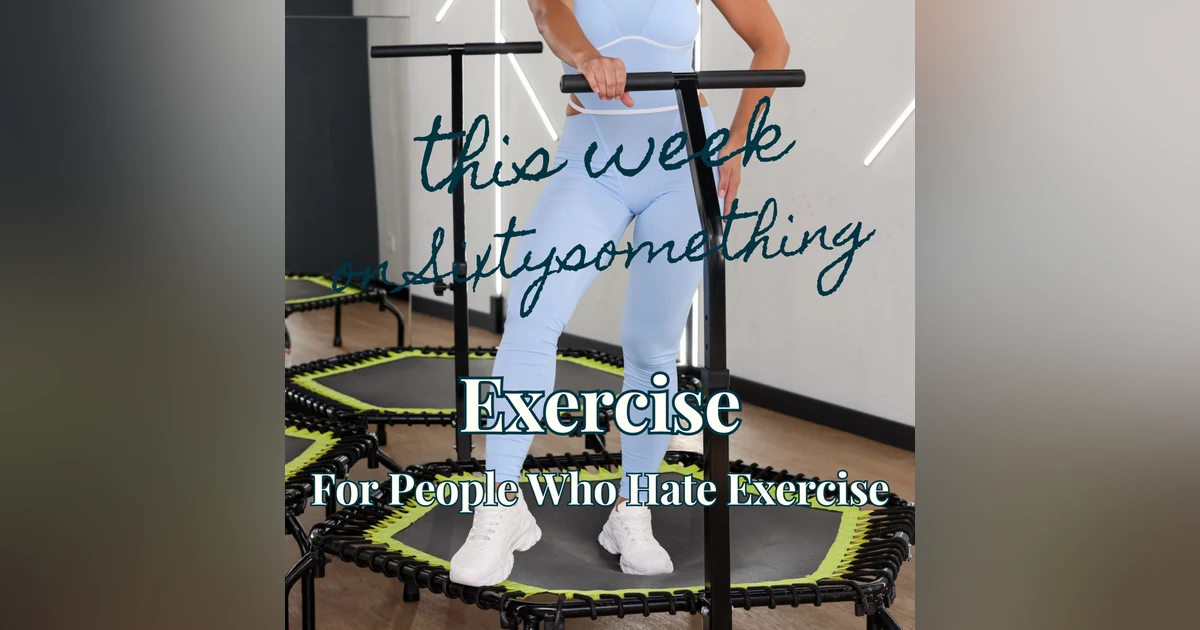

Sixtysomething - Season 2 - Episode 6
Exercise for People Who Hate Exercise: Less Friction, More Fun
In this episode of Sixtysometing, your host, Grace Taylor Segal, shares shares her struggle to exercise despite knowing it’s important for strength, balance, mobility, and keeping up with travel and grandkids.
She explains how making exercise a “production” creates resistance, so she’s focusing on low-friction movement she’ll actually do, including a rebounder (mini trampoline with support bar) and ropeless jump-rope handles.
She describes starting with just two minutes to reduce mental barriers, notes that fun can be the key to consistency, and cautions against exaggerated health claims while mentioning limited research suggesting possible balance and mobility benefits.
She emphasizes safety (stable setup, small movements, medical guidance for health concerns) and proposes a flexible “menu” of options—treadmill with TV, walking, bike, rebounding, ropeless rope, and eventually safe kettlebell work—because some activity is better than none.
* * * * * * * * * * * * * * * * * * * * * * * * * * * * * * * * * * *
Hey Friends! It's me, Grace! I just want to thank you for listening. I hope you’ll let me know what you think about the podcast and if any particular episodes resonate with you.
Listed just below here is my contact information and all of the social channels where you can find me, as well as the link to our Facebook Group.
Contact Info
Grace Taylor Segal
Email: grace@gracetaylorsegal.com
Facebook: 60something Page
(https://www.facebook.com/profile.php?id=61553062496332)
Instagram: @60somethingpod
Facebook Group: 60Something Pod
https://www.facebook.com/groups/1665326354000332
RESOURCES
Rebounder Lady
https://www.youtube.com/@PausingTime
My Rebounder - here
Crossrope - $100+ (Aaron’s) - here
Amazon Crossrope - $18 (Grace’s) - here
Kathy Smith Step Routine Video (My Favorite) - here
Shuffle Dance - here
Credits
Sixtysomething Theme Song
Music & lyrics by Lizzy Sanford
Vocals by Lizzy Sanford
Guitar: Lizzy & Coco Sanford
To Leave a Review:
On Apple Podcasts (no link is available--here are the steps)
- Open the Apple Podcasts app.
- Search for the podcast you want to review.
- Select the podcast show page (not an individual episode).
- Scroll to the bottom of the page.
- Click "Write a Review".
On the Sixtysomething Podcast Website
https://www.sixtysomething.net/reviews/new/
Thank you so much for taking the time to review the show!
Timestamps:
00:00 Exercise Hater Intro
01:47 Why It Matters Now
02:57 My Low-Friction Routine
04:23 Making Exercise Smaller
06:06 Rebounder Breakthrough
10:09 Why Fun Works
12:47 Rebounding Claims Reality
15:21 Safety First Setup
17:59 Ropeless Jump Rope
22:08 Learning Curve Barrier
25:48 Strength Training Thoughts
27:38 Guidelines Without Guilt
29:05 Build a Movement Menu
31:18 Less Friction Mindset
34:22 What Counts Is Doing
36:07 Share Your Ideas Outro
37:35 Wrap Up And Next Time
ref-sa2zfeml
Sixtysomething - S3 - Ep 6 - Exercise for People Who Hate Exercise
[00:00:00] Welcome back to 60-Something. I'm Grace, and I'm so glad you're here. Today, we're talking about exercise for people who hate exercise, and I wanna be very clear right at the beginning that when I say people, I mean me. I am people. I don't really enjoy exercising. I wish I did. I have always wished I were one of those people who wake up and just can't wait to go work out, the, the people who have those adorable exercise clothes set out the night before and feel strange if they miss a day.
This is my husband, really. I mean, maybe his clothes aren't that cute, but he definitely has [00:01:00] a whole wardrobe of workout clothes for pickleball, for, cycling, for... And shoes, too. It's incredible. But I've gotta be honest, I have never once felt strange because I missed a workout. Relieved maybe, guilty perhaps, but not strange.
Now, I have had periods in my life, as long as two years, when I did work out faithfully. I went to the gym for two years. I used to ride bikes with Aaron before he became a, quote-unquote, "cyclist" with the fancy bike. But it just has never come naturally to me, and yet here I am in my 60s, and I know, believe me, I know [00:02:00] that exercise is important.
I wanna stay strong. I want my balance to be good. I wanna be able to get down on the floor and play with my grandkids, and most importantly, do all of the things that I need to do to keep up. I wanna travel and keep up with my sons and my daughter when I do. I wanna carry my own groceries and do all the things I assume I'll still be doing 10 years from now, 20 years, I don't know, maybe.
So I'm not confused about whether exercise matters. The problem is in getting myself to do it. My normal routine, if we [00:03:00] can call something I rarely do, maybe on a good week three times a week, is 20 minutes on our Peloton treadmill while I watch a show I do not take the Peloton classes. I know people love them and swear by them, but I don't want that rah-rah with me while I'm exercising.
I don't wanna be told to dig deeper. I- this is as deep as I can go. I don't wanna be told I'm crushing it. I just wanna watch an entertaining show and forget that I'm walking on a treadmill. This is my f- fitness philosophy. We also have an old-fashioned, non-electric exercise bike, as well as a Peloton bike that I don't [00:04:00] use.
When I say old-fashioned, uh, I mean it doesn't light up, it doesn't connect to an app, it doesn't give me a badge or encourage me in any way. It has never asked me to renew a subscription. You just get on the thing and you pedal. Very easy. But I really do wanna make some kind of movement part of every day, and I've been thinking a lot about why this has been so hard for me.
I don't think it's because I'm just lazy. I work at stuff all the time. I can spend 10 hours at the computer without blinking if I'm working on something that, you know, is really drawing me in. I think maybe it's because I've turned exercise into a whole production in my [00:05:00] mind. Oh, I need to change my clothes, find a class or a show, learn a routine, sweat, shower, devote some large chunk of the day, or even some small chunk of the day, to a thing I don't even enjoy.
Of course I resist it. I've made it sound terrible. So lately I'm trying to ask myself a different question. What kind of exercise would I actually do if it didn't feel so much like exercise? What could I do for just a couple minutes without learning anything, without driving anywhere, without anyone yelling, without a long mental argument with myself first?
And that question has led me to a couple of things that [00:06:00] might seem a bit ridiculous and surprisingly fun. A rebounder, which is a little mini trampoline, and a ropeless jump rope First the rebounder. So Aaron got me one for my birthday at my request, a wonderful gift, so kind. Exactly the sort of thing I...
Well, I flat out told him, "Will you get this? I want this. I think it might work for me." And then it sat in the box for two whole months. Two months. Why? Well, I had to put it together, and I thought it would be hard. It, I thought it would be a project. It has those bungee cords and everything. I pictured directions that would be hard to understand, and the bolts, and the missing parts, and [00:07:00] At least one point where Aaron and I would have to hold opposite sides while one of us said, "No, turn it the other way," and kinda get, a little irritated with each other.
Oh, I just walked past that box for two months feeling guilty and frustrated every time I saw it, and I made sure to keep it in the living room where I saw it all the time. And then one night, I just finally put it together. Do you know how long it took? It took 15 minutes. 15 minutes, and that was with a little complicated part.
So I'd spent two months avoiding something that took 15 minutes. Isn't that just the perfect metaphor for my relationship with exercise? Yeah. It was perfect. Once it was assembled, though, I did get on it, and I [00:08:00] liked it. A rebounder is, if you don't know, it's basically a small trampoline, and the one that I have has a bar 'cause I'm really careful about falls at my age.
I can take a fall. I've got a good amount of meat on my bones, unlike my mother, my grandmother, who were like little birds even at my age, 68. But the jumping on the trampoline, it's not jumping around in the air like a six-year-old or doing anything that would cause Aaron to come running from another room worried about me.
You can keep your feet pretty much right on the, the mat. You just soften your knees, and you make very gentle up-and-down movement. They call it a health bounce, which sounds a little grander [00:09:00] than what I'm doing, but fine. I'm health bouncing, and the thing that I like most is that there's almost no learning curve.
There's no learning curve. Get the thing together. Get on. You can hold the bar if you want to, which I do, and I bounce. That's it. I can shift from side to side. I could march a little. I could put on musing or watch a show. I can do just two minutes and stop. I go for 10.
There isn't a screen with someone doing some steps I can't follow along easily while cheerfully shouting at me, "You've got this," when we may both know how perfectly well I do not. But it is simple. It [00:10:00] feels fun. Now, that's a word I don't use very much when I talk about exercising, but that's what it's been like for me.
We're told all of this dead serious stuff, like we need to protect our bones, build muscle, improve our balance, strengthen our hearts, maintain our mobility. I totally buy into that. They're all true, all important, all quite serious. But what about doing something 'cause it's fun? What if fun is not like a bonus?
What if fun is the thing that gets us to do it again tomorrow? You know, I gave Gemini Notebook several rebounding videos and a booklet and some other resources that I found online and from a woman that I follow on YouTube, uh, who does [00:11:00] rebounding videos for 60-plus people. Her whole approach is geared toward folks our age.
It starts very gently, and, that appeals to me. One of the ideas I especially liked was you can begin with two minutes or five minutes, and it's very beneficial. I know two minutes is not going to transform my cardiovascular health. I'm not crazy. But two minutes does something very important for me.
It remu- removes that excuse that I always say to myself, 'cause I can do two minutes, and I can... Once I do two minutes, I can almost always stay for five or 10. The trick is that I don't have [00:12:00] to. I'm a very rebellious person by nature. I always have been, and I rebel against my own self. It's crazy. But if I tell myself, "You've gotta do 10 minutes.
You've gotta do 20," I may do nothing. If I tell myself, "Well, just two minutes, you could do that," I probably will do that. This is where I am now in life. Learning that a tiny version that I can actually get myself to do is infinitely more useful than this huge, ambitious goal that I keep postponing. Now, if you look into rebounding online, you will phone- find some very enthusiastic claims.
Apparently, it can do everything except reorganize your garage, which [00:13:00] I need. I wish it would You'll hear about lymphatic drainage, and detoxing, and weight loss, and bone density, and brain health, and back pain, and cortisol, and I wanna be very careful about these things because, once some folks fall in love with a form of exercise or anything for that matter, and they put it on the internet, it tends to turn into a cure-all.
And that is not the case with ri- rebounding. There, there is some interesting research on this type of exercise, including small studies in older adults. Some structured programs have improved balance, mobility, strength, walking ability, and helped with the fear of falling. [00:14:00] That's encouraging. These were actual programs, regular, supervised, or planned sessions, not just a couple of minutes of bouncing.
But the research on bone density is not conclusive yet, and I couldn't find support for some of the bigger claims about detoxing, cortisol, or weight loss. But I'm not presenting the rebounder as magic. I'm suggesting it as a pleasant way to move that I myself actually will use. You know, that's enough.
Everything doesn't have to be a miracle cure. If it helps get me off the chair, use my legs, challenge my balance a bit, and enjoy myself for 10 minutes, it has done something valuable. I'll tell you [00:15:00] what, a little exercise for me tends to translate in a little more exercise. If I do the rebounder, there's a good chance I'm going to do the treadmill today or tomorrow.
It just sort of puts me in a more active mood. I do wanna put a safety note in here because a rebounder is... can be an unstable surface, and we're not little kids. Use the support bar if you need it, and make sure and get a rebounder with a support bar. I always use it. Aaron doesn't use it. He just turns it around.
It d- mine doesn't fold down like I wish it would, but if you turn it to one side, the rebounder is, the bar is in the back of you, so it doesn't interfere with his bouncing. Yes, he uses it too [00:16:00] So make sure also that you are careful when you put the thing together, follow the d- directions. Make sure it's on a level, non-slip surface, and start with tiny movements.
If you have balance problems, dizziness, osteoporosis, a recent injury or surgery, pelvic floor issues, heart concerns, or anything else that makes exercise more complicated, just speak with your doctor or physical therapist about what is safe for you, and follow the instructions for your rebounder again.
Now, for me, I am very, very careful getting on and off of this thing, particularly getting off. I have the barb, but I also have a chair right there. Like I said, I am super careful about falling [00:17:00] because we all know, that can be a negative turning point, even at my age, 68. So and again, I am just sharing what I'm trying.
In no way is this prescriptive for anyone listening. It's up to you and your medical professional Also, one useful beginner tip, if you do get a rebounder, when you use it, keep your whole foot involved rather than just bouncing only on your toes. If your calves start screaming at you almost immediately, you may be up on the balls of your feet.
Soft knees, small movement, heel connected. Much better. [00:18:00] The second thing Aaron and I are doing is called crossrope, or more specifically, ropeless jump rope. It's exactly what it sounds like. Jump rope handles with short weighted cords, and sometimes there are little weights at the ends, but no long rope going over your head and under your feet.
You rotate the handles as if you're jumping rope, except there's nothing to trip over, nothing to hit the ceiling, nothing smacking your ankles every time your timing's off. Frankly, I think advanced adulthood has already given us enough ways to fall down, don't you? We don't need to add another. Oh, I used to jump rope as a child constantly.
I don't even remember learning how. Kids are [00:19:00] so amazing that way. They just do things. As an adult, when I've tried to jump rope, yeah, I just don't really have the coordination that I used to. As an adult, I'm suddenly aware of the floor, my knees, the furniture, the dog, and the fact that, ugh, an unexpected fall is no longer a funny story.
The ropeless handles let me have the motion and the rhythm without having to clear the rope under my feet, and it is very strenuous. You'd be surprised. And again, there's almost nothing to learn. I can stand. I can rotate the handles. I could march. I could use them while I'm gently bouncing. I don't do that, but Aaron does.
My arms... Well, his arms, 'cause I don't do it, th- are [00:20:00] doing something, which is nice because the rebounder by itself is working out your legs and your balance. The handles come in different weights, and we started light because a weight rotating at the end of a cord can feel much heavier than it looks Aaron, of course, my workout nut, has now added both the rebounder and the ropeless handles with weights to his own fitness routine, which is quite robust, and, I love that.
I can't emulate it, but I do love it. I admire it. So do the ropeless handles have some special scientifically proven advantage over moving your arms with light weights? Well, I don't know, but it, it's more fun. It's like a rhythm. I like them. [00:21:00] Aaron likes them. It- almost all of them come with some kind of app that they connect with, and they will, provide stats on what...
how many... I guess how many rotations and calories and that kind of thing. There are high-end that you can buy from Crossrope, or there are, $30, Crossrope knockoffs that you can get on Amazon. Then they come with an app So one of the things I love about it is it makes me feel like that little girl I once was, going out on the driveway and jumping rope for hours.
Now it's more like five minutes on a good day, but it's something. It counts. It makes me feel good, like [00:22:00] I'm actually doing something Doing something for my health. This whole experiment has made me think about the enormous importance of the learning curve. I am also considering going back to Kathy Smith's step routine, which I used to do all the time.
Now we're talking about when I was in my 40s. I love Kathy Smith. She's got every workout you can think of. I particularly love the step routines. I still have a step, and I just loved it, but I had to learn it, and there's the problem. It was great once I knew the steps. Up, down, up, down it begins. Fine, I can do that.
Then the instructor adds a turn, changes the lead foot, throws in an arm movement, says [00:23:00] something like, "Now give me a repeater," as we... as if we covered that in some kind of orientation. By the time everyone has... moving on to... everyone's moving on, you know, to the next step, I'm just kind of standing there trying to figure out where I went wrong.
I can relearn it, of course. Maybe I will. But relearning, I've found, is for me a real barrier because, remember I wanted to do shuffle dancing, , I wanna do weight training, but those are barriers for me. And I'm finally trying to be honest with myself about barriers instead of pretending, oh, they don't matter, I can do that, you know, just in a snap.
If I have to find the video, set up the [00:24:00] step or whatever I'm using, learn the combination, and feel quite out of it for several sessions before I can start enjoying it and getting something out of it, I'm much less likely to begin that than I am with something I can just jump onto and do immediately. As I missaid, as I just said, the same is, true of the shuffle dancing, tap dancing, both of which I'd really like to learn.
They look like so much fun and great exercise. But As appealing as it is to be a woman in her 60s pushing 70 who can suddenly break into a shuffle,
That learning curve, lessons, practice, a stretch of time when my feet appear to be [00:25:00] going in, you know, different directions. And maybe that's okay. Maybe one of those will become my thing, and the learning itself will turn out to be part of the fun. But I've noticed that I use the learning curve as a reason to never get started with anything new I can't make a complicated new skill the foundation of my daily exercise habit.
I've realized that. I think for me, the thing that requires, or the things that require no thought should be the foundation. A new skill can be the adventure. I also have a kettlebell, and I just bought a simple program, it was a PDF with a video that uses just one kettlebell, and that [00:26:00] appeals to me because it's one thing and one video, a few movements.
I might be able to do that, but I've had it for a couple months now, and I haven't tackled it. I know that strength training and movement really matter, especially as we get older. With weight training, the general recommendation is strength work at least two days a week alongside the aerobic activity and balance work.
I take that seriously. You know, kettlebells are quite simple. It's a weight with a handle. How hard could it be? Well, a kettlebell swing is not just flinging the thing forward and hoping for the best. Form matters, your back matters, your shoulders matter. So I will be following the [00:27:00] program I bought if I get around to it, and use a manageable weight, and learn the movements properly.
You can really hurt yourself with those kettlebells. I'm not prescribing this for you. It's something I'm considering doing, and I will report back and, uh, you know, this episode is not called Everything Grace Has Mastered. It's called Exercise for People Who Hate Exercise. Let me be a, work in progress.
We're allowed. Personally, I don't have any choice The official activity recommendation for older adults is at least 150 minutes of moderate aerobic activity a week, strength work on two or more days, and [00:28:00] activities that improve balance. That is useful to know, but that is a lot for me.
It's the kind of thing that can make someone like me doing 20 minutes three times a week on the treadmill think, "Well, forget it. I'm already behind." But the same guidelines say that some activity is better than none, and that we should be as active as our abilities and conditions allow. I think that part needs to be at the top of our list.
So I'm not going to leap from exerc- exercising three times a week to a seven-day master plan with zones and charts and a whole new identity. I know how that movie ends. I'll do it enthusiastically for four days, miss a day, declare my system broken, [00:29:00] and go back to Netflix without the treadmill. Instead, I'm trying to make this little menu for myself.
On the day when I don't wanna exercise, I can bounce for a little bit. On a better day, maybe I'll bounce longer and add the cross rope. Or I can do my 20-minute treadmill walk with Netflix. It's getting cooler here in the desert. I could walk the dog. I could pedal my old exercise bike If I learn what I'm supposed to do with those kettlebells, I could use them too.
There is no single perfect choice and no reason why every day has to look the same I also want to [00:30:00] attach movement to something that already happens. Before I start a show, after I make coffee, before I take a shower, because sometime later is not a time, it's not a commitment. Sometime later today is where every task I don't wanna do goes to die, right?
One of the suggestions in the material I read was to bounce after dinner. The packet that I read made some claims about lowering cortisol, sleeping better, and preventing late-night snacking, and you know I need help with that. I can't say that those are facts, but they do seem possible. If five minutes on that rebounder also keeps me from, uh, uh, [00:31:00] going back to the kitchen for second dinner or second dessert, fabulous.
But if exercising in the evening wakes you up, don't do it. We're not all the same people, so you have to decide for yourself. Probably my biggest realization from all of this. I have spent too much time trying to be a person who loves exercise instead of helping the person I am move a little more.
It doesn't help living with a fitness nut, but opposites attract. The person I am likes TV. She likes simple equipment, no shouting. She is very [00:32:00] good at postponing anything that feels like a big deal. She enjoys things that are fun, and she will almost always do two minutes of anything if two minutes counts for something.
So why don't I design a routine for her and stop building fitness plans for some imaginary lady who springs out of bed at 6:00 in the morning thrilled to do pushups? That gal has never lived here. The man does, but not this girl. Maybe you recognize yourself in this. Maybe you know exactly what you're supposed to do, but you simply cannot make yourself do it.
What if the answer isn't more discipline? What if the [00:33:00] answer is less friction? Put the thing where you can see it. Make the first step ridiculously small and easy. Let entertainment help, music, a show you love, and choose exercise that doesn't require a tutorial or spending a lot of money
Just stop insisting that it has to be impressive or even terribly challenging. Maybe ask yourself what you enjoyed before exercise became medicine Did you ride a bike? I won't ride a bike outside anymore because of the falling component. Did you dance? Did you swim? Did you just walk [00:34:00] around at Costco or the mall?
Jump rope? Work in the garden? There may be a form of movement you don't hate because your brain doesn't file it under workout, and you don't think of it as exercise, but it counts. It counts, too. I'm not sure whether the rebounder will be something I use every day. I don't know whether I'll stick with the ropeless handles, they're kind of hard for me, if I can re-educate myself with Cathy Smith and my step workouts, learn to shuffle dance, or become a lady who has strong opinions about kettlebell form.
But I do know that I'm more interested in moving now than I was when my only [00:35:00] idea of exercise was getting on the treadmill or going to the gym That's worth paying attention to Convenience matters. Fun counts. The exercise that is theoretically perfect but lives forever on our to-do list is not better than the more modest thing we actually do.
So my plan for now, very simple, two minutes if that's all I can get myself to do. More is welcome and likely, but not required. The treadmill with Netflix or whatever show I can get on there still counts, and the non-electric bike counts. Gentle bouncing counts. Ropeless handles count. Kettlebell work will count once I do it, I learn to do it safely.
And if I spend a half hour trying to shuffle [00:36:00] dance and mostly confusing which foot goes where, darn it, I'm gonna count that, too. Really love to know what works for you, especially if you're more like me and don't love exercise. What can you tolerate? What do you actually enjoy? Yoga seems to me like a thing that I would enjoy, but the learning curve, it discourages me.
Do you walk while listening to audiobooks? Dance a bit in the kitchen? Use one little piece of equipment you share, boy. You've... Use one little piece of equipment you swear by. Like remember when Suzanne Somers had the ThighMaster? I, I think that thing worked. Tell [00:37:00] me, what you do in the Sixty Something Facebook group, because we exercise avoiders need to share intelligence.
And if you're thinking about trying a rebounder, weights, kettlebell, anything else new, especially if you have health or balance concerns, remember, it's important to check with your doctor or physical therapist. The goal is to keep ourselves moving, not prove something and end up able to move at all, right?
I'll put some links in the show notes to some of the th- resources I've talked about in this episode. Now, if you enjoy Sixty Something, I'd be so grateful if you'd leave a review and share this episode with a friend, especially if that friend would rather watch a, a show than be crushing it in the gym.[00:38:00]
Thank you for spending this time with me. Maybe I'll go get on the rebounder now for a couple of minutes. I may stay for 10. No promises, though. I have some special episodes coming up for you, including my first interview with a non-relative. I'll keep you posted on that, and remember, we still have our book club, and we will be talking about Remarkably Bright Creatures in the next episode, which will be coming soon, I swear.
So I'll see you next time on Sixty-Something. Till then, keep your sunny side [00:39:00] up.